


Why Side Sleepers Need a Different Pillow
Before we talk about what the best pillow for side sleepers is, let’s talk about why you need a different pillow in the first place.
When you sleep on your side, your shoulder presses into the mattress, leaving your head farther away from the surface. This means you need a pillow with enough height to fill the space and keep your neck properly aligned. And yes, this is the reason why pillows for side sleepers are usually higher than regular pillows for back sleepers.
Tip: Old pillows can also affect sleep quality more than people realize. Flattened fill and worn-out support often lead to neck and shoulder discomfort. You should replace your pillow every one to two years.
The Best Pillows for Side Sleepers
The best pillows for side sleepers include memory foam, contour or cervical, latex, adjustable fill, and down or down alternatives. Here is a closer look at different types of pillows for side sleepers.
Memory Foam Pillows
With memory foam, it contours around your head and neck and maintains consistent support throughout the night. The caveat? Heat. Memory foam’s dense structure makes it less breathable than other pillow types. Fortunately, there are hybrid memory foam pillows that combine traditional memory foam, usually with a layer of cooling gel infusions or hyper-elastic polymer grids.
Another thing to consider before picking a memory foam pillow? The maintenance. Most memory foam only needs spot cleaning, while its cover can be washed regularly.
Contour / Cervical Pillows
If you come across pillows with an ergonomic design, that’s what you call a contour or cervical pillow. This design is specifically intended to support your neck while giving your head its own resting area. And yes, that also means that you can have a more consistent sleeping position through the night.
The only problem is that cervical pillows are usually one-size-fits-all. If the shape or height doesn’t work for you, you’re pretty much stuck with it.
Fun Fact: This pillow type is called cervical because the contoured portion is for the cervical spine of the upper backbone portion where your neck is.
Latex Pillows
With latex pillows, expect a spring-back-like feedback as you move. Instead of slowly molding around your head, it pushes back almost immediately. It’s also breathable and cooler. The trade-off, however, is that latex pillows are pricier and are quite firm.
Tip: Can’t decide between latex and memory foam pillows? If you prefer a more responsive feel, pick latex. But if you like a slower sink-feel, a memory foam pillow is better for you.
Adjustable / Shredded Fill
If you don’t know how much loft you need, consider getting an adjustable or shredded fill. As its name implies, this pillow lets you add or remove the fill (typically shredded latex or foam) as you see fit. This gives you the opportunity to dial in the exact height you need, without having to buy multiple pillows.
One perfect example is Olive + Crate’s BreathePure Cooling Adjustable Pillow.
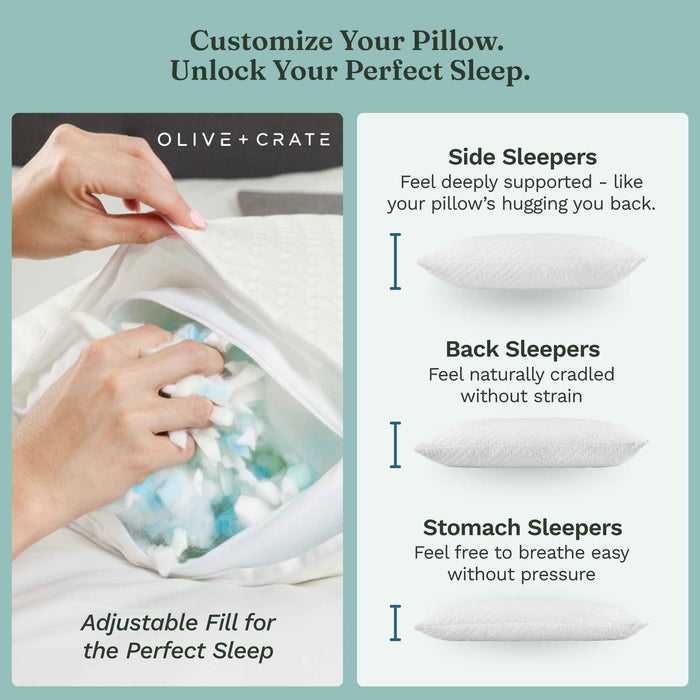
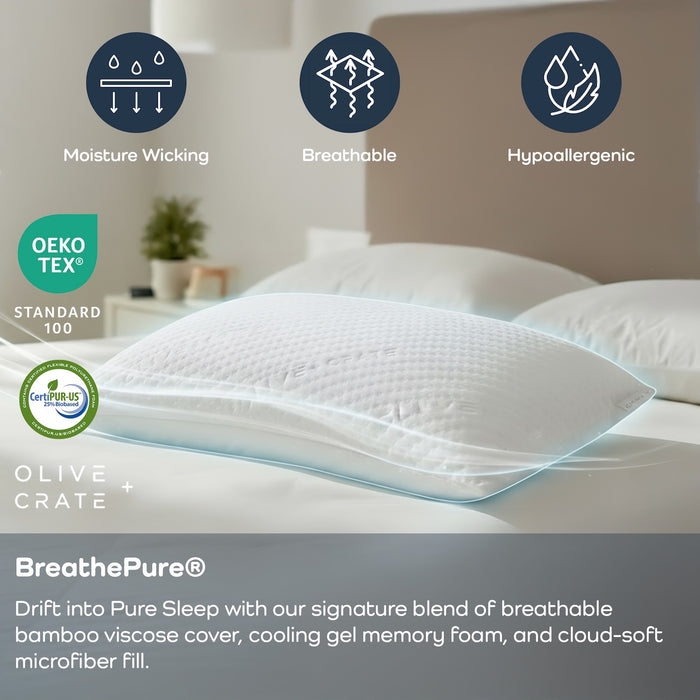
Once you unzip its washable cover, you can access the adjustable fill inside. You can remove some of the fill until you find the perfect loft. And, if you prefer a high loft? Well, don’t worry, because an extra 300gms memory foam blend fill is included.
And unlike standard pillows, Olive + Crate adjustable pillows feature cooling gel layers and breathable bamboo viscose material, making them an ideal choice for hot sleepers as well.
Down/Down Alternative
Down pillows are the softest and most compressible. And yes, this softness can work against you. So you have to find one with a firm density and a high loft height. Another thing to consider with down pillows? They need more careful washing and drying.
What to Look for in a Pillow for Side Sleeping?
When shopping for a pillow for side sleeping, you should take into account the height, firmness, shoulder cutout, fill material, and even cooling properties.
Loft
One of the most important factors in choosing a pillow is the loft or the height. Ideally, you should look for medium to high loft pillows, which are around 3 to 5 (or more) inches.
To find out where you fall within the recommended range, you have to take into consideration how broad your shoulders are. Generally, if there is a large gap to fill (between your shoulders and head to be aligned), a higher-loft pillow is generally better —around 5 inches or more is a great starting point. On the flip side, those with narrower shoulders should look at lower or medium-loft pillows.
Something else to keep in mind: Your mattress matters, too. If your mattress is on the firmer side and your shoulder doesn't sink very far into the surface, you may need a higher pillow. But if you have a softer mattress and your shoulder sinks farther into it, you may need a lower pillow.
Firmness
Once you find the right loft, the next thing you should consider is how firm the pillow is. Why? The firmness is the resistance that stops your head from sinking too far. Of course, an excessively firm pillow can be uncomfortable as it can create too much pressure around your ear and jaw.
So, how firm should your pillow be? For most people, medium to medium-firm support is more than enough. Again, don’t overlook your mattress, as it can affect how much your shoulder sinks into the surface and how much support your pillow needs.
Here’s a simple breakdown:
- Too soft: the head sinks too low
- Too firm: pressure builds around the neck and shoulder
- Medium-firm: balanced support and alignment
Fill Material
Don’t forget to consider the fill material, too, because it affects both support and feel. For instance, memory foam provides a slower, more gradual sink-in feel while offering more contoured support to the shape of your neck and head. On the other hand, latex pillows are cooler and more responsive.
Aside from comfort, care and maintenance can also vary depending on the fill material.
Shoulder Cutouts/Contouring (Optional)
Don’t be surprised if you find a pillow with either a shoulder cutout or contour. It might look odd, but these designs give your shoulder more room while keeping the pillow close to your neck. And if you sleep with your arm underneath the pillow? The shape can make a noticeable difference because you are not putting pressure on your arm. But do you need this feature? Most side sleepers don’t need it since a pillow with the right loft and firmness is usually enough, but it’s still a welcome feature.
Cooling Properties (Optional)
If you are a hot sleeper and regularly wake up in the middle of the night sweating, don’t forget to consider the pillow’s cooling properties, too. As mentioned earlier, memory foam retains heat, but newer designs have ventilation holes to improve airflow. Latex pillows are breathable, too, because their open-cell structure allows air to flow freely.
And again, don’t forget that there are pillows like the Olive + Crate BreathePure Cooling Adjustable Pillow, which features a cooling gel layer and breathable bamboo viscose for maximum breathability.

Common Questions About Pillows for Side Sleepers