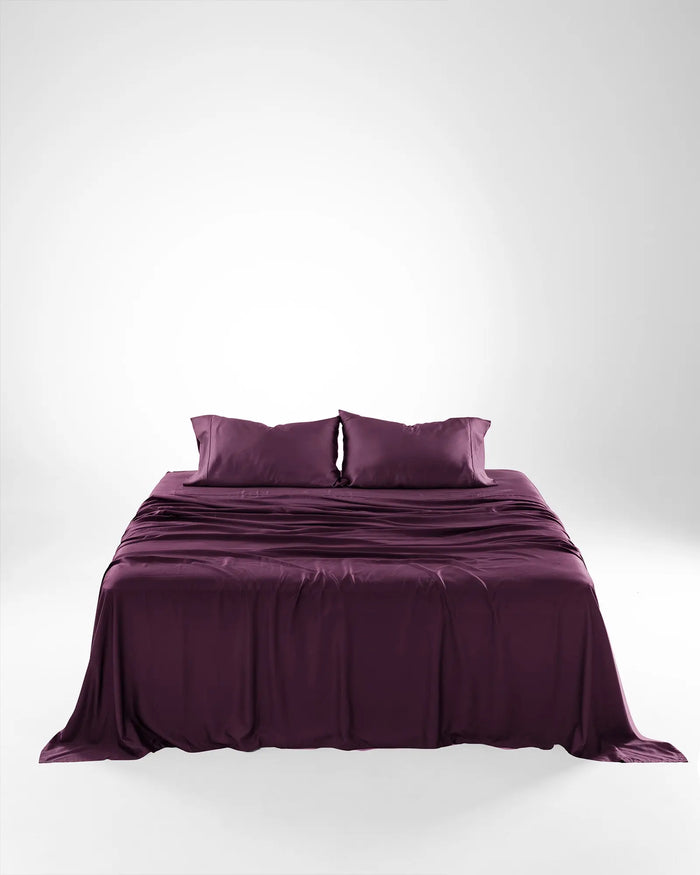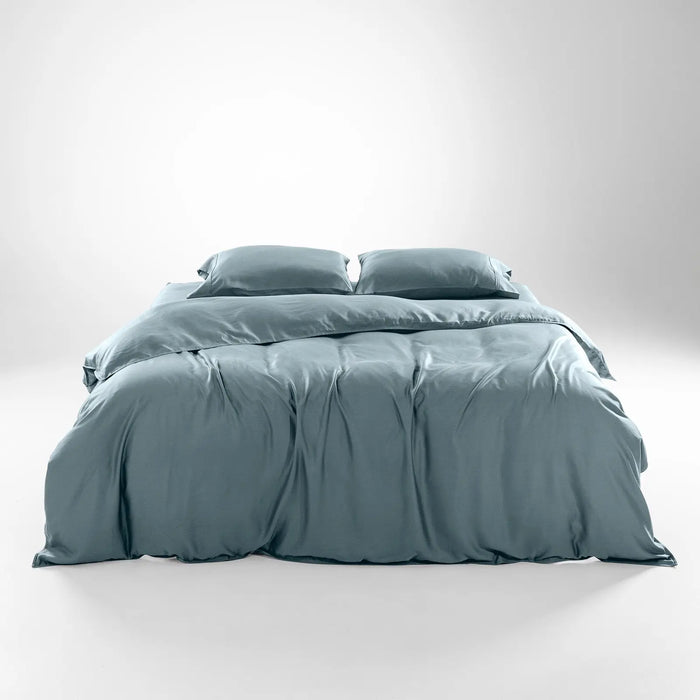



The Foundational Rule: Dividing the Bed
Before we get into the individual pieces, let’s start with the rule that brings the whole look together.
As we teased earlier, you should divide the bed roughly in half horizontally. The top half should be dedicated to pillows, euros, and cushions, while the bottom half is for your duvet or comforter and throw.
Pro Tip: Look at your bed and see whether there is a visual marker that can help. It could be the feet of your bed or the floorboard that gives you a reference point. Once you’ve found that point, you don’t have to keep guessing where everything should sit.
You should then divide each half into thirds. For the bottom half, you have the folded-back duvet, the throw, and the remaining space is for the rolled duvet cover. In the top half, you have your sleeping pillows, your euros, and then your decorative cushions.
But why do this in the first place? Well, this gives every layer its own space, making the bed feel more balanced than overcrowded.
Pillows & Cushions
Now that you know how to divide your bed, the next step is to build the top half. For your basic arrangement, start with 2 sleeping pillows stacked flat, then standing euros in front of them, followed by your decorative cushions.
One of the most common mistakes is using pillows that are too small for the bed. For example, queen-size pillows can look undersized when they’re spread across a king bed. On a queen bed, though, queen pillows are the right proportion.
What if you have a king bed but only have a pair of king-size sleeping pillows and the rest are queen-size? You could still make it work by putting the king pillows on the bottom and placing the queen pillows on top. This helps close the gap while still giving you a layered look.
As for the euro shams, you should have one per person sleeping in the bed. Don’t worry if this leaves a small gap between them because your lumbar cushion will sit in front and help hide that space. What you don’t want is to chop your euros. Your euros should remain visible as a complete layer. If a cushion cuts across them awkwardly, the arrangement can start to look cramped.
For your final layer, you have different cushion options. You can have one long lumbar cushion, two shorter breakfast cushions, or two bolsters. If you prefer breakfast cushions, make them the same width as your euros for symmetry. Keep in mind that you don’t have to stick to just one style. For instance, if you prefer a fuller look, you can combine a bolster with a short breakfast cushion.
Pro Tip: For more styling flexibility, opt for double-sided cushions.
Throws
Once your pillows and cushions are in place, we can move down to the bottom half of the bed, which is where the throw comes in. And yes, placement makes a huge difference.
Typically, throws are placed hanging over the side of the bed or sitting diagonally, but these are already dated. What you want to do is pull the throw flat, fold it into thirds, then place it in the middle third of the lower half of the bed, just underneath the lip of the folded-back duvet.
Pro Tip: If you don’t have a throw yet, a double-sided design gives you more styling flexibility. You can have two colors or even two different textures in one piece, so you can change the look throughout the seasons without adding more layers.
Comforter
If you are using a comforter rather than a duvet cover, there is a slightly different way to approach the fold. However, that doesn’t mean the overall layout changes; you still want to use the same half-bed principle we discussed earlier.
If you are using a colored comforter, place a flat sheet underneath it. Then, fold the flat sheet over the comforter so the seam sits on top. Having the sheet between you and the comforter means the sheet can be washed more frequently without having to wash the entire comforter every time.
Pro Tip: When you fold the comforter back, try a double fold. This gives that first section a little more height and makes the layers look more substantial.
This approach makes a lot of sense in a guest room since it is easier to set up, swap, and launder than a full duvet setup.
Again, the same half-bed division still applies for a comforter. What changed is the folding technique, not the layout principle.
Extra Pro Tip: If your colored comforter fits inside a duvet cover, you get two styling options.
Artwork Above the Bed
Artwork can completely change how the bed feels, but just like the bed itself, proportion is key.
When you’re choosing a piece, don’t just think about whether you like artwork; you should also consider whether it’s large enough for the bed. As a general rule, your artwork should span roughly two-thirds of the bed’s width. For a one-piece artwork, the size is roughly around 90 x 110 for a king bed and 92 x 92 for a queen bed.
You’d also want to leave around 15 to 20 centimeters between the top of the headboard and the bottom of the artwork. Why? That small space helps seamlessly connect the artwork to the bed without making the two feel crowded. And yes, the same principle applies to both king and queen beds.
There are a few ways you can approach the layout of the artwork:
- You could just choose one large piece.
- Pick two pieces together.
- A three-piece triptych.
One large piece is usually preferred because multiple small pieces can easily look ‘lost’ above a large bed, especially if the dimensions aren't right.
What if you don’t have a traditional headboard? That’s not a problem. A half-dado wall can create a similar visual anchor and give the bed a strong backdrop.
Pro tip: For the color strategy, choose art with a range of tones (e.g., pinks, plums, whites, greens + an accent pop) so you have flexibility to rotate bedding colors over time while keeping the art as a fixed piece that is still able to anchor colors together.
Quick Recap
And there you have it! Timeless and elegant styling for queen and king beds boils down to thoughtful proportions, intentional layering, and proper artwork layout. Just to recap:
Bed Layout
- Dedicate the top half of the bed to all pillows and cushions.
- Dedicate the bottom half of the bed to the duvet cover (or comforter) and the throw.
- Divide each half into thirds to keep the layers balanced. The top half is pillows, euros, and then cushions, while the bottom half is for the duvet cover rolled/folded over (around 40cm), the throw, and the rest of the duvet.
Pillows, Euros, and Cushions:
- Use appropriately sized pillows for the bed. King beds need king-size sleeping pillows, while queen beds work with queen-size pillows. You can also place king pillows on the bottom and queen pillows on top.
- Keep euros intact and don’t worry about a small gap between them.
- One euro per person on the bed.
- Double-sided options that feature different fabric types or slightly different colors on each side to provide more styling options.
- Bolster: A cushion shaped like a log with round ends, 40 x 60 cm. Ideally, it should be plump and firm.
- Long lumbar: 90cm x 30cm. The inside should feel spongy.
- Short breakfast cushion: Rectangular-shaped cushion placed in front of the euros. The ideal firmness is between plump and firm. Ideally, half the height of the euros.
- Euro cushion: 60 x 60cm and should not be chopped.
Throws
- Fold into thirds and tuck it neatly beneath the lip of the folded-back duvet.
- Keep it flat rather than scrunched.
- Use texture to add another layer of interest to the bed.
Comforter
- Place a flat sheet underneath it and fold the sheet over the top.
- Pull the sheet and comforter back about a third of the way, bunching them into two layers, then drape the comforter over.
Artwork:
- Generally, two-thirds of the bed’s width. For a one-piece artwork, the size is roughly around 90 x 110 for a king bed and 92 x 92 for a queen bed.
- 15 to 20 cm clearance between the artwork and the headboard.
Styling Don'ts
- Don’t chop or intentionally crease the top of euros. Keep them visible and let them form their own layer.
- Don’t stand up your sleeping pillows. They should sit flat and create the foundation for the layers in front.
- Don’t place your throw diagonally across the bed. Fold it into thirds and position it neatly underneath the folded-back duvet.
- Avoid undersized artwork. If the artwork is too small, it can look lost above the bed.
- Don’t use a comforter without a flat sheet. The sheet provides a protective layer and makes your bedding easier to maintain.